MENU

Translator

English French German Spain Italian Dutch Russian Portuguese Japanese Korean Arabic Chinese Simplified
Tampilkan postingan dengan label Material. Tampilkan semua postingan

Senin, 14 Mei 2012

Stainless Steel SUS 304

Formula Kimia
Fe, <0.08% C, 17.5-20% Cr, 8-11% Ni, <2% Mn, <1% Si, <0.045% P, <0.03% S


Komposisi
Typical compositional ranges untuk grade 304 stainless steels diberikan di table 1.
Table 1. Composition ranges untuk 304 grade stainless steel


Latar Belakang
Grade 304 adalah standard "18/8" stainless; Jenis Stainless steel yang paling serbaguna dan paling luas pemakaiannya,tersedia dalam range produk yang luas,yang mempunyai bentuk dan finish yang bagus disbanding dengan jenis yang lain.mempunyai karakteristik welding dan forming yang bagus. keseimbangan austenitic structure dari Grade 304 memampukan untuk diproses tanpa intermediate annealing, sehingga membuat grade ini dominan di industri manufaktur stainless parts seperti sinks, hollow-ware dan saucepans. Untuk aplikasi ini sering digunakan "304DDQ" (Deep Drawing Quality) variants. Grade 304 sudah banyak aplikasinya di bidang industrial, architectural, dan transportation. Grade 304 welding characteristics yang bagus. Post-weld annealing tidak dibutuhkan ketika welding section yang tipis.
Grade 304L, versi low carbon dari 304, tidak membutuhkan post-weld annealing dan dipakai secara luas dalam heavy gauge components (lebih dari 6mm). Grade 304H dengan kadar carbon yang tinggi diapplikasikan pada temperature yang tinggi. Austenitic structure juga memberikan grade ini ketangguhan yang bagus, meskipun pada cryogenic temperatures.

Properties
Properties ini cocok untuk untuk flat rolled product (plate, sheet and coil) di ASTM A240/A240M.


Mechanical Properties

Typical mechanical properties for grade 304 stainless steels are given in table 2.
Table 2. Mechanical properties of 304 grade stainless steel


Physical Properties
Typical physical properties for annealed grade 304 stainless steels are given in table 3.
Table 3. Physical properties of 304 grade stainless steel in the annealed condition


Grade Specification Comparison
Approximate grade comparisons for 304 stainless steels are given in table 4.
Table 4. Grade specifications for 304 grade stainless steel


Possible Alternative Grades
Possible alternative grades to grade 304 stainless steels are given in table 5.
Table 5. Possible alternative grades to 304 grade stainless steel


Ketahanan Korosi
Mempunya ketahanan yang bagus terhadap karat.kelemahannya pada pitting dan keretakan akibat corrosion di warm chloride environments, dan pada stress corrosion cracking diatas kira-kira 60°C. mempunyai ketahana pada Air yang dapat diminum dengan kira-kira diatas 200mg/L chlorides pada ambient temperatures, berkurang dengan kisaran 150mg/L pada 60°C. 


Ketahanan Panas
Ketahanan Oksidasi yang bagus di intermittent service pada 870°C dan di continuous service pada 925°C. Pemakaian kontinu dari 304 pada 425-860°C range tidak direkomendasikan jika subsequent aqueous corrosion resistance bersifat utama. Grade 304L lebih tahan terhadap pengendapan carbide dan bisa dipanaskan diatas temperature rangenya.
Grade 304H mempunyai strength yang lebih tinggi pada temperature tinggi jadi selalu dipakai untuk structural dan aplikasi yang terdapat pressure pada temperature diatas kisaran 500°C dan di atas 800°C. 304H akan menjadi sensitif pada temperature range antara 425-860°C; ini bukan masalah untuk temperature aplikasi yang tinggi,tetapi akan mengurangi aqueous corrosion resistancenya.


Perlakuan Panas
Solution Treatment (Annealing) – dipanaskan hingga 1010-1120°C dan diudinginkan secara cepat. Jenis ini tidak bisa dihardening dengan menggunakan perlakuan thermal.


Aplikasi
Umumnya meliputi:
• Peralatan untuk proses makanan, umumnya di pemasakan beer, Proses susu & pembuatan wine.
• Kitchen benches, sinks, troughs, equipment and appliances
• Architectural panelling, railings & trim
• Chemical containers, termasuk untuk transportasinya
• Perpindahan panas
• Woven or welded screens for mining, quarrying & water filtration
• Threaded fasteners
• pegas


Sumber: Atlas Steels Australi

http://widyaprasetya.blogspot.com

Sabtu, 12 November 2011

Cara Membuat Baja Menurut Al Quran (by Ali Said)

Metalurgi adalah ilmu yang mempelajari bagaimana membuat suatu logam dari campuran logam dengan unsur lain. Qur’an dalam bahasa yang sederhana menceritakan bagaimana baja dibuat, dengan memberikan cerita tentang perjalanan Zul Qarnain ke suatu tempat di antara dua bukit (Surat Al Kahfi S 18:92-97). Di antara kedua bukit tersebut Zul Qarnain bertemu dengan orang-orang yang hampir-hampir tidak mengerti perkataan orang lain. Orang-orang tersebut mengadu padanya tentang Ya’juj dan Ma’juj dan bagaimana mereka telah membuat kerusakan dan korup. Orang-orang tersebut meminta Zul Qarnain sekiranya dia dapat membuat pembatas antara mereka dan Ya’juj dan Ma’juj. Maka diapun membuatkan pembatas tersebut dengan meminta bantuan orang-orang tersebut, dan apa yang dia kerjakan seperti yang dijelaskan pada ayat berikut (QS 18:96):   

“Berilah aku potongan-potongan besi (masses of iron). Hingga ketika besi itu telah sama rata dengan kedua bukit itu, berkatalah dia (Dzulqarnain): “Tiuplah”. Hingga ketika besi itu sudah menjadi merah seperti api, diapun berkata “Berilah aku QITHR agar kutuangkan ke atas besi panas itu” (QS Al Kahfi ayat 96). 

Perlu dijelaskan di sini bahwa ada sedikit variasi atau perbedaan dalam terjemahan terhadap ayat tersebut khususnya berkaitan dengan kata “QITHRAAN”. Ketika penulis bandingkan sekitar 8 terjemahan (2 versi bahasa Indonesia dan 6 versi bahasa Inggris), secara umum dapat kita kelompokkan menjadi 4 kelompok dalam menerjemahkan kata “Qithraan”. Keempat terjemahan tersebut memiliki perbedaan yang sangat signifikan. Keempat jenis terjemahan tersebut adalah (molten) copper (tembaga yang meleleh/mendidih), (molten) lead (timah yang meleleh), (molten) brass (kuningan yang meleleh), dan tar (ter/tir).

Dalam Tafsir Ibnu Katsir, Tafsir Jalalen, Tafsir Thabari and Tafsir Qurtubi, kata “qithr” ditafsirkan sebagai “tembaga”. Kata “yang meleleh (molten)” merupakan tafsiran tambahan. Jika kita lihat Kamus Inggris-Indonesia-Arab susunan Attabik Ali, diperoleh bahwa arti dari qithr adalah tar (Inggris) dan ter/tir (Indonesia).   Untuk menentukan terjemahan yang paling tepat, hal ini dapat ditinjau dari perspektif sains modern. Berdasarkan ilmu metalurgi, baja dibuat dari dua unsur yaitu besi dan karbon. Selanjutnya jika kita amati, ter/tir (yang berwarna hitam yang merupakan campuran aspal dan minyak dan bisa juga disebut sebagai minyak mentah) jelas banyak mengandung unsur karbon. Jadi dalam cerita Zulkarnain di atas jelas apa yang seharusnya dituangkan kedalam besi telah memerah panas seperti api adalah tir/ter, karena dengan menuangkan ter/tir tersebut terjadilah percampuran antara besi dan karbon sehingga terbentuklah baja, yang sifatnya lebih keras dan kuat dibandingkan besi. Maka pada ayat berikutnya (QS Al Kahfi ayat 97) diceritakan “mereka tidak bisa melobanginya”. 

Selain itu jika kata “qithran” diterjemahkan sebagai ‘tembaga’, ‘timah’, atau ‘kuningan’, maka diperlukan sebuah penafsiran lagi (tafsiran tambahan) yaitu ‘yang meleleh’. Kalau diterjemahkan atau ditafsirkan sebagai ‘ter/tir’ tidak perlu ada penafisran tambahan karena tir/ter memang bentuknya sudah cair sehingga tinggal disiramkan saja ke atas besi yang sudah panas membara seperti api. Dengan demikian, QS Al Kahfi Ayat 96 akan lebih tepat diterjemahkan sebagai berikut: 

Berilah aku potongan-potongan besi. Hingga ketika besi itu telah sama rata dengan kedua bukit itu, berkatalah dia (Dzulqarnain): “Tiuplah”. Hingga ketika besi itu sudah menjadi merah seperti api, diapun berkata “Berilah aku ter/tir agar kutuangkan ke atas besi panas itu.

Walloohu a’lam

Tambahan:
Dan Kami ciptakan BESI yang padanya terdapat kekuatan yang hebat dan berbagai manfaat bagi manusia. (QS 57-Al Hadiid ayat 25)


Jumat, 07 Oktober 2011

MENGENAL JENIS PLASTIK


Plastik adalah salah satu bahan yang dapat kita temui di hampir setiap barang. Mulai dari botol minum, TV, kulkas, pipa pralon, plastik laminating, gigi palsu, compact disk (CD), kutex (pembersih kuku), mobil, mesin, alat-alat militer hingga pestisida.
Para ahli di dunia telah sepakat membuat kode untuk mengenali bahan-bahan pembuat plastik. Tujuannya tentu untuk memudahkan konsumen mengenali bahaya dan keamanan wadah yang terbuat dari plastik. Kode ini berupa angka yang biasanya ditempatkan di bokong kemasan dalam tanda berbentuk segitiga.
Bagaimana membaca kode itu?
Segitiga menunjukkan bahwa kemasan plastik tersebut adalah produk daur ulang. Lalu, kode angka pada segitiga itu saling berkaitan dengan huruf yang ada di bawahnya. Angka dan huruf ini menunjukkan jenis plastik penyusunnya. Hingga saat ini, ada tujuh kode pada kemasan plastik yang biasa digunakan:
#1. PETE atau PET
Artinya plastik tersebut tersusun dari polyethylene terephthalate. Kemasan dengan angka ini berarti mengandung 30% PET. Biasa dipakai untuk botol plastik yang jernih/transparan/tembus pandang seperti botol air mineral, botol jus, dan hampir semua botol minuman lainnya. Botol-botol dengan bahan #1 dan #2 direkomendasikan hanya untuk sekali pakai. Bahan ini juga tidak balk untuk menyimpan makanan serta minuman panas, karena akan mengakibatkan lapisan polimer pada botol bermigrasi ke makanan atau minuman. Buang botol yang sudah lama atau terlihat baret-baret.
#2. HDPE
Bahan kemasan plastik ini tersusun oleh high sensity polyethylene (HDPE). Bahan baku plastik ini aman karena tidak bereaksi terhadap makanan atau minuman. Bahan ini lebih kuat, keras, buram, dan lebih tahan terhadap suhu tinggi sehingga biasa dipakai pada botol susu berwama putih susu, tupperware, galon air minum, dan kursi lipat.
Meski begitu, kemasan ini juga tidak untuk dipakai berulangkali. Sebab senyawa antimoni trioksida terus meningkat seiring waktu dan itu berbahaya bagi kesehatan kita.
#3. V atau PVC
Polyvinyl chloride adalah plastik yang paling sulit didaur ulang. Plastik ini bisa ditemukan pada plastik pembungkus (cling wrap), dan botol-botol. Kandungan dari PVC yaitu DEHA yang terdapat pada plastik pembungkus dapat bocor dan masuk ke makanan berminyak bila dipanaskan. Kandungan DEHA mudah bermigrasi pada suhu 15 derajat celcius. Bahan ini berbahaya dan sulit mengalami daur ulang.
PVC berpotensi berbahaya untuk ginjal, hati dan berat badan.
#4. LDPE
Bahan ini terbuat dari low density polyethylene yang terbuat dari minyak bumi. Sifatnya kuat, agak tembus cahaya, fleksibel, dan permukaannya agak berlemak. Pada suhu di bawah 60 derajat celcius, sangat resisten terhadap senyawa kimia. Meski punya daya proteksi terhadap uap, air baik, akan tetapi kurang baik bagi gas-gas yang lain seperti oksigen.
Barang dengan kode #4 bisa dibilang tidak dapat di hancurkan tetapi tetap baik untuk tempat makanan dan juga dapat di daur ulang dan baik untuk barang-barang yang memerlukan fleksibilitas tetapi kuat.
#5. PP
Kemasan ini terbuat dari polypropylene yang merupakan pilihan terbaik untuk bahan plastik terutama untuk yang berhubungan dengan makanan dan minuman seperti tempat menyimpan makanan, botol minum dan terpenting botol minum untuk bayi.
Biasa ditemukan pada botol transparan tapi tidak terlalu jernih atau berawan. Plastik jenis ini berkarakter lebih kuat, ringan, dengan daya tembus uap yang rendah. Makanya plastik jenis ini aman untuk kemasan makanan dan minuman, juga tahan terhadap lemak dan stabil terhadap suhu tinggi.
Cari simbol ini bila membeli barang berbahan plastik.
#6. PS
Ini adalah menandakan kemasan ini terbuat dari polystyrene (PS) atau biasa disebut polimer aromatik. Saat bertemu dengan makanan atau minuman, bahan ini dapat mengeluarkan bahan styrene. Bahan ini harus dihindari karena berbahaya untuk kesehatan otak, mengganggu hormon estrogen pada wanita yang berakibat pada masalah reproduksi, pertumbuhan dan sistem saraf.
Banyak dipakai dalam produk-produk elektronik sebagai casing, kabinet dan komponen-komponen lainya. Peralatan rumah tangga yang terbuat dari polistirena, a.l: sapu, sisir, baskom, gantungan baju, ember.
#7. Other
Artinya bahan ini tersusun selain dari enam bahan plastik yang disebutkan di atas. Kandungannya antara lain styrene acrylonitrile (SAN), acrylonitrile butadiene styrene (ABS), polycarbonate (PC) dan nylon.
Kandungan SAN biasa terdapat pada tempat makanan dan minuman seperti botol minum olahraga, suku cadang mobil, alat-alat rumah tangga, komputer, alat-alat elektronik, dan plastik kemasan.
Kandungan ABS biasa untuk bahan mainan lego dan pipa. SAN dan ABS memiliki resistensi tinggi terhadap reaksi kimia, kuat, dan tingkat kekerasannya dapat ditingkatkan tapi aman.
Adapun PC biasanya ada pada botol susu bayi, gelas anak batita, botol minum polikarbonat, dan kaleng kemasan makanan dan minuman, termasuk kaleng susu formula. Kandungan PC berpotensi merusak sistem hormon, kromosom pada ovarium, penurunan produksi sperma, dan mengubah fungsi imunitas.
Masih banyak sekali barang plastik yang tidak mencantumkan simbol-simbol ini, terutama barang plastik buatan lokal di Indonesia . Oleh karena itu, kalau anda ragu lebih baik tidak membeli. Kalaupun barang bersimbol lebih mahal, harga tersebut lebih berharga dibandingkan kesehatan keluarga kita.
Pada akhirnya. Hindari penggunaan plastik apapun di Microwave. Gunakan bahan keramik, gelas atau pyrex sebagai gantinya.


JENIS PLASTIK BERDASARKAN NOMOR
#1 PETE/PET
#1. PETE/PET
PETE atau PET (polyethylene terephthalate) biasa dipakai untuk botol plastik tembus pandang/transparan seperti botol air mineral, botol minuman, botol jus, botol minyak goreng, botol kecap, botol sambal, botol obat, dan botol kosmetik dan hampir semua botol minuman lainnya. Untuk pertekstilan, PET digunakan untuk bahan serat sintetis atau lebih dikenal dengan polyester
PETE/PET direkomendasikan HANYA UNTUK SEKALI PAKAI. Penggunaan berulang kali terutama pada kondisi panas akan menyebabkan melelehnya lapisan polimer dan keluarnya zat karsinogenik dari bahan plastik tersebut, sehingga dapat menyebabkan kanker untuk penggunaan jangka panjang.
#2 HDPE
#2. HDPE
HDPE (high density polyethylene) memiliki sifat bahan yang lebih kuat, keras, buram dan lebih tahan terhadap suhu tinggi.
HDPE biasa dipakai untuk botol kosmestik, botol obat, botol minuman, botol susu yang berwarna putih susu, tupperware, galon air minum, kursi lipat, dan jerigen pelumas dan lain-lain.
Walaupun demikian HDPE hanya direkomendasikan untuk sekali pakai, karena pelepasan senyawa antimoni trioksida terus meningkat seiring waktu. Bahan HDPE bila ditekan tidak kembali ke bentuk semula.
#3 PVC
#3 PVC
PVC (polyvinyl chloride), yaitu jenis plastik yang paling sulit didaur ulang. Jenis plastik PVC ini bisa ditemukan pada plastik pembungkus (cling wrap), untuk mainan, selang, pipa bangunan, taplak meja plastik, botol kecap, botol sambal dan botol sampo
PVC mengandung DEHA yang berbahaya bagi kesehatan. Makanan yang dikemas dengan plastik berbahan dapat terkontaminasi karena DEHA lumer pada suhu -15oC
#4 LDPE
#4. LDPE
LDPE (low density polyethylene) yaitu plastik tipe cokelat (thermoplastic/dibuat dari minyak bumi), biasa dipakai untuk tempat makanan, plastik kemasan, dan botol-botol yang lembek. LDPE dipakai untuk tutup plastik, kantong/tas kresek dan plastik tipis lainnya. Walaupun baik untuk tempat makanan, barang berbahan LDPE ini sulit dihancurkan. Selain itu pada suhu di bawah 60oC sangat resisten terhadap senyawa kimia.
#5 PP
#5. PP
Jenis PP (polypropylene) ini adalah pilihan bahan plastik terbaik, terutama untuk tempat makanan dan minuman seperti tempat menyimpan makanan, tutup botol, cup plastik, mainan anak, botol minum dan terpenting botol minum untuk bayi.
Bahan yang terbuat dari PP bila ditekan akan kembali ke bentuk semula.
#6 PS
#6 PS
PS (polystyrene) biasa dipakai sebagai bahan tempat makan styrofoam, tempat minum sekali pakai seperti sendok, garpu gelas, dan lain-lain. Polystyrene dapat mengeluarkan bahan styrene ke dalam makanan ketika makanan tersebut bersentuhan. Bahan ini harus dihindari, karena berbahaya untuk kesehatan, selain itu bahan ini sulit didaur ulang. Banyak negara bagian di Amerika sudah melarang pemakaian tempat makanan berbahan styrofoam termasuk negara China.
#7 OTHER
#7. OTHER
Untuk jenis plastik 7 Other ini ada 4 jenis, yaitu : SAN (styrene acrylonitrile), ABS (acrylonitrile butadiene styrene), PC (polycarbonate), dan Nylon.
SAN dan ABS memiliki resistensi yang tinggi terhadap reaksi kimia dan suhu, kekuatan, kekakuan, dan tingkat kekerasan yang telah ditingkatkan sehingga merupakan salah satu bahan plastik yang sangat baik untuk digunakan dalam kemasan makanan ataupun minuman.
Biasanya terdapat pada mangkuk mixer, pembungkus termos, piring, alat makan, penyaring kopi, dan sikat gigi, sedangkan ABS biasanya digunakan sebagai bahan mainan lego dan pipa.
PC atau Polycarbonate dapat ditemukan pada botol susu bayi, gelas anak batita (sippy cup), botol minum polikarbonat, dan kaleng kemasan makanan dan minuman, termasuk kaleng susu formula.
Dapat mengeluarkan bahan utamanya yaitu Bisphenol-A ke dalam makanan dan minuman yang berbahaya bagi kesehatan sehingga dianjurkan untuk tidak digunakan sebagai tempat makanan ataupun minuman .
Ironisnya banyak botol susu yang terbuat dari PC dan sangat mungkin mengalami proses pemanasan untuk tujuan sterilisasi dengan cara merebus, dipanaskan dengan microwave, atau dituangi air mendidih atau air panas.

Sumber:http://mastermesin.com

Kamis, 06 Oktober 2011

ALLOY (LOGAM CAMPURAN) STEEL / BAJA

Berikut ini adalah panjelasan singkat padat mengenai alloy steel atau logam campuran baja. Silakan  dibuka aja  Alloy Steel 


Sumber: http://repository.ui.ac.id/contents/koleksi/11/52a8232fd496fbc195d36b27a663eaa6d5503b89.pdf

Selasa, 16 Agustus 2011

Stainless Steel - How Product are Made

Background

Stainless steel is a product of ferrous alloy metallurgical and known to it’s character as a product designed to persist from corrosion. From the name itself “stainless steel” means resist from corrosion. Namely Chromium a metal containing in this alloy that useful to resist the corrosion. Particularly about 12 % of Chromium added. Some type of stainless steel are made depend on how much percentage of material containing.

Stainless steel is an iron-containing alloy—a substance made up of two or more chemical elements—used in a wide range of applications. It has excellent resistance to stain or rust due to its chromium content, usually from 12 to 20 percent of the alloy. There are more than 57 stainless steels recognized as standard alloys, in addition to many proprietary alloys produced by different stainless steel producers. These many types of steels are used in an almost endless number of applications and industries: bulk materials handling equipment, building exteriors and roofing, automobile components (exhaust, trim/decorative, engine, chassis, fasteners, tubing for fuel lines), chemical processing plants (scrubbers and heat exchangers), pulp and paper manufacturing, petroleum refining, water supply piping, consumer products, marine and shipbuilding, pollution control, sporting goods (snow skis), and transportation (rail cars), to name just a few.
About 200,000 tons of nickel-containing stainless steel is used each year by the food processing industry in North America. It is used in a variety of food handling, storing, cooking, and serving equipment—from the beginning of the food collection process through to the end. Beverages such as milk, wine, beer, soft drinks and fruit juice are processed in stainless steel equipment. Stainless steel is also used in commercial cookers, pasteurizers, transfer bins, and other specialized equipment. Advantages include easy cleaning, good corrosion resistance, durability, economy, food flavor protection, and sanitary design. According to the U.S. Department of Commerce, 1992 shipments of all stainless steel totaled 1,514,222 tons.
Stainless steels come in several types depending on their microstructure. Austenitic stainless steels contain at least 6 percent nickel and austenite—carbon-containing iron with a face-centered cubic structure—and have good corrosion resistance and high ductility (the ability of the material to bend without breaking). Ferritic stainless steels (ferrite has a body-centered cubic structure) have better resistance to stress corrosion than austenitic, but they are difficult to weld. Martensitic stainless steels contain iron having a needle-like structure.
Duplex stainless steels, which generally contain equal amounts of ferrite and austenite, provide better resistance to pitting and crevice corrosion in most environments. They also have superior resistance to cracking due to chloride stress corrosion, and they are about twice as strong as the common austenitics. Therefore, duplex stainless steels are widely used in the chemical industry in refineries, gas-processing plants, pulp and paper plants, and sea water piping installations.

Raw Materials

Stainless steels are made of some of the basic elements found in the earth: iron ore, chromium, silicon, nickel, carbon, nitrogen, and manganese. Properties of the final alloy are tailored by varying the amounts of these elements. Nitrogen, for instance, improves tensile properties like ductility. It also improves corrosion resistance, which makes it valuable for use in duplex stainless steels.

The Manufacturing
Process

The manufacture of stainless steel involves a series of processes. First, the steel is melted,
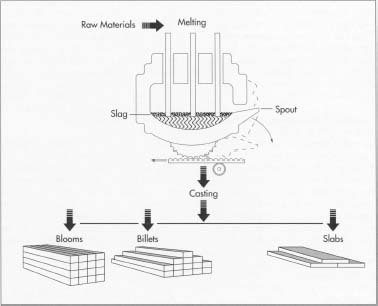
To make stainless steel, the raw materials—iron ore, chromium, silicon, nickel, etc.—are melted together in an electric furnace. This step usually involves 8 to 12 hours of intense heat. Next, the mixture is cast into one of several shapes, including blooms, billets, and slabs.
and then it is cast into solid form. After various forming steps, the steel is heat treated and then cleaned and polished to give it the desired finish. Next, it is packaged and sent to manufacturers, who weld and join the steel to produce the desired shapes.

Melting and casting

  • 1 The raw materials are first melted together in an electric furnace. This step usually requires 8 to 12 hours of intense heat. When the melting is finished, the molten steel is cast into semi-finished forms. These include blooms (rectangular shapes), billets (round or square shapes 1.5 inches or 3.8 centimeters in thickness), slabs, rods, and tube rounds.

Forming

  • 2 Next, the semi-finished steel goes through forming operations, beginning with hot rolling, in which the steel is heated and passed through huge rolls. Blooms and billets are formed into bar and wire, while slabs are formed into plate, strip, and sheet. Bars are available in all grades and come in rounds, squares, octagons, or hexagons 0.25 inch (.63 centimeter) in size. Wire is usually available up to 0.5 inch (1.27 centimeters) in diameter or size. Plate is more than 0.1875 inch (.47 centimeter) thick and over 10 inches (25.4 centimeters) wide. Strip is less than 0.185 inch (.47 centimeter) thick and less than 24 inches (61 centimeters) wide. Sheet is less than 0.1875 (.47 centimeter) thick and more than 24 (61 centimeters) wide.

Heat treatment

  • 3 After the stainless steel is formed, most types must go through an annealing step. Annealing is a heat treatment in which the steel is heated and cooled under controlled conditions to relieve internal stresses and soften the metal. Some steels are heat treated for higher strength. However, such a heat treatment—also known as age hardening —requires careful control, for even small changes from the recommended temperature, time, or cooling rate can seriously affect the properties. Lower aging temperatures produce high strength with low fracture toughness, while higher-temperature aging produces a lower strength, tougher material. Though the heating rate to reach the aging temperature (900 to 1000 degrees Fahrenheit or 482 to 537 degrees Celsius) does not effect the properties, the cooling rate does. A post-aging quenching (rapid cooling) treatment can increase the toughness without a significant loss in strength. One such process involves water quenching the material in a 35-degree Fahrenheit (1.6-degree Celsius) ice-water bath for a minimum of two hours.
    The type of heat treatment depends on the type of steel; in other words, whether it is austenitic, ferritic, or martensitic. Austenitic steels are heated to above 1900 degrees Fahrenheit (1037 degrees Celsius) for a time depending on the thickness. Water quenching is used for thick sections, whereas air cooling or air blasting is used for thin sections. If cooled too slowly, carbide precipitation can occur. This buildup can be eliminated by thermal stabilization. In this method, the steel is held for several hours at 1500 to 1600 degrees Fahrenheit (815 to 871 degrees Celsius). Cleaning part surfaces of contaminants before heat treatment is sometimes also necessary to achieve proper heat treatment.

Descaling

  • 4 Annealing causes a scale or build-up to form on the steel. The scale can be removed using several processes. One of the most common methods, pickling, uses a nitric-hydrofluoric acid bath to descale the steel. In another method, electrocleaning, an electric current is applied to the surface using a cathode and phosphoric acid, and the scale is removed. The annealing and descaling steps occur at different stages depending on the type of steel being worked. Bar and wire, for instance, go through further forming steps (more hot rolling, forging, or extruding) after the initial hot rolling before being annealed and descaled. Sheet and strip, on the other hand, go through an initial annealing and descaling step immediately after hot rolling. After cold rolling (passing through rolls at a relatively low temperature), which produces a further reduction in thickness, sheet and strip are annealed and descaled again. A final cold rolling step then prepares the steel for final processing.

Cutting

  • 5 Cutting operations are usually necessary to obtain the desired blank shape or size to trim the part to final size. Mechanical cutting is accomplished by a variety of methods, including straight shearing using guillotine knives, circle shearing using circular knives horizontally and vertically positioned, sawing using high speed steel blades, blanking, and nibbling. Blanking uses metal punches and dies to punch out the shape by shearing. Nibbling is a process of cutting by blanking out a series of overlapping holes and is ideally suited for irregular shapes. Stainless steel can also be cut using flame cutting, which involves a flame-fired torch using oxygen and propane in conjunction with iron powder. This method is clean and fast. Another cutting method is known as plasma jet cutting, in which an ionized gas column in conjunction with an electric arc through a small orifice makes the cut. The gas produces extremely high temperatures to melt the metal.

Finishing

  • 6 Surface finish is an important specification for stainless steel products and is critical in applications where appearance is also important. Certain surface finishes also make stainless steel easier to clean, which is obviously important for sanitary applications. A smooth surface as obtained by polishing also provides better corrosion resistance. On the other hand, rough finishes are often required for lubrication applications, as well as to facilitate further manufacturing steps. Surface finishes are the result of processes used in fabricating the various forms or are the result of further processing. There are a variety of methods used for finishing. A dull finish is produced by hot rolling, annealing, and descaling. A bright finish is obtained by first hot rolling and then cold rolling on polished rolls. A highly reflective finish is produced by cold rolling in combination with annealing in a controlled atmosphere furnace, by grinding with abrasives, or by buffing a finely ground surface. A mirror finish is produced by polishing with progressively finer abrasives, followed by extensive buffing. For grinding or polishing, grinding wheels or abrasive belts are normally used. Buffing uses cloth wheels in combination with cutting compounds containing very fine abrasive particles in bar or stick forms. Other finishing methods include tumbling, which forces
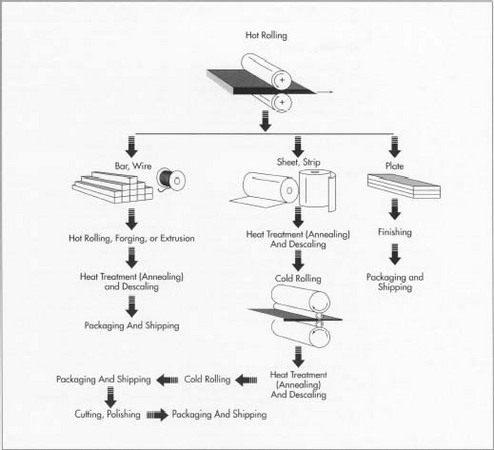
    The initial steel shapes—blooms, billets, slabs, etc.—are hot rolled into bar, wire, sheet, strip, and plate. Depending on the form, the steel then undergoes further rolling steps (both hot and cold rolling), heat treatment (annealing), descaling Ito remove buildup), and polishing to produce the finished stainless steel. The steel is then sent the end user.
    The initial steel shapes—blooms, billets, slabs, etc.—are hot rolled into bar, wire, sheet, strip, and plate. Depending on the form, the steel then undergoes further rolling steps (both hot and cold rolling), heat treatment (annealing), descaling Ito remove buildup), and polishing to produce the finished stainless steel. The steel is then sent the end user.
    movement of a tumbling material against surfaces of parts, dry etching (sandblasting), wet etching using acid solutions, and surface dulling. The latter uses sandblasting, wire brushing, or pickling techniques.

Manufacturing at the fabricator or
end user

  • 7 After the stainless steel in its various forms are packed and shipped to the fabricator or end user, a variety of other processes are needed. Further shaping is accomplished using a variety of methods, such as roll forming, press forming, forging, press drawing, and extrusion. Additional heat treating (annealing), machining, and cleaning processes are also often required. There are a variety of methods for joining stainless steel, with welding being the most common. Fusion and resistance welding are the two basic methods generally used with many variations for both. In fusion welding, heat is provided by an electric arc struck between an electrode and the metal to be welded. In resistance welding, bonding is the result of heat and pressure. Heat is produced by the resistance to the flow of electric current through the parts to be welded, and pressure is applied by the electrodes. After parts are welded together, they must be cleaned around the joined area.

Quality Control

In addition to in-process control during manufacture and fabrication, stainless steels must meet specifications developed by the American Society for Testing and Materials (ASTM) with regard to mechanical properties such as toughness and corrosion resistance. Metallography can sometimes be correlated to corrosion tests to help monitor quality.

The Future

Use of stainless and super stainless steels is expanding in a variety of markets. To meet the requirements of the new Clean Air Act, coal-fired power plants are installing stainless steel stack liners. Other new industrial applications include secondary heat exchangers for high-efficiency home furnaces, service-water piping in nuclear power plants, ballast tanks and fire-suppression systems for offshore drilling platforms, flexible pipe for oil and gas distribution systems, and heliostats for solar-energy plants.
Environmental legislation is also forcing the petrochemical and refinery industries to recycle secondary cooling water in closed systems rather than simply discharge it. Reuse results in cooling water with elevated levels of chloride, resulting in pitting-corrosion problems. Duplex stainless steel tubing will play an increasingly important role in solving such industrial corrosion problems, since it costs less than other materials. Manufacturers are developing highly corrosion-resistant steels in respond to this demand.
In the automotive industry, one steel manufacturer has estimated that stainless-steel usage per vehicle will increase from 55 to 66 pounds (25 to 30 kilograms) to more than 100 pounds (45 kilograms) by the turn of the century. New applications include metallic substrates for catalytic converters, air bag components, composite bumpers, fuel line and other fuel-system parts compatible with alternate fuels, brake lines, and long-life exhaust systems.
With improvements in process technology, superaustenitic stainless steels (with nitrogen contents up to 0.5 percent) are being developed. These steels are used in pulp-mill bleach plants, sea water and phosphoric-acid handling systems, scrubbers, offshore platforms, and other highly corrosive applications. A number of manufacturers have begun marketing such materials in sheet, plate, and other forms. Other new compositions are being developed: ferritic iron-base alloys containing 8 and 12 percent Cr for magnetic applications, and austenitic stainless with extra low sulfur content for parts used in the manufacture of semiconductors and pharmaceuticals.
Research will continue to develop improved and unique materials. For instance, Japanese researchers have recently developed several. One is a corrosion-resistant stainless steel that displays the shape-memory effect. This type of material returns to its original shape upon heating after being plastically deformed. Potential applications include assembly components (pipe fittings, clips, fasteners, clamps), temperature sensing (circuit breakers and fire alarms), and springs. An improved martensitic stainless steel has also been developed for precision miniature and instrument rolling-contact bearings, which has reduced vibration levels, improved life expectancy, and better surface finish compared to conventional materials.

Where To Learn More

Books

Cleaning and Descaling Stainless Steels. American Iron and Steel Institute, 1982.
Finishes for Stainless Steel. American Iron and Steel Institute, June, 1983.
Llewellyn, D. T. Steels: Metallurgy & Applications. Butterworth-Heinemann, 1992.
MacMillan, Angus, ed. The Steel-Alloying Handbook. Elkay Publishing Services, 1993.
Stainless Steel & Heat Resisting Steels. Iron & Steel Society, Inc., 1990.

Periodicals

Davison, Ralph M. and James D. Redmond. "Practical Guide to Using Duplex Stainless Steels." Materials Performance. January, 1990, pp. 57-62.
Hasimoto, Misao. "Combined Deposition Processes Create New Composites." Research & Development. October, 1989.
Tuthill, Arthur and Richard Avery. "Specifying Stainless Steel Surface Treatments." Advanced Materials & Processes. December, 1992, pp. 34-38.
L. S. Millberg

Read more: How stainless steel is made - material, manufacture, used, processing, parts, components, structure, steps, industry, Raw Materials, The Manufacturing Process of stainless steel http://www.madehow.com/Volume-1/Stainless-Steel.html#ixzz1V9eSxlRV

Sumber:http://www.madehow.com/Volume-1/Stainless-Steel.html